
There are some Disney attractions that you ride once and immediately start thinking about when you can ride them again. The Magic of Disney Animation is not that kind of experience.
And that is exactly why I think it could become one of the most interesting additions to Disney’s Hollywood Studios in years. There is no giant drop. No launch. No track. No elaborate ride vehicle waiting around the corner. Instead, Disney has taken something far more fundamental to its identity, the art of animation itself, and built an entire experience around it.
After years of watching this corner of Hollywood Studios lose some of its original identity, The Magic of Disney Animation feels like a return to something the park has always been very good at: making guests feel as though they have stepped behind the scenes of a movie.
Only this time, the movie is animated. With Cast Member previews now underway ahead of its official opening on 14th September 2026, the first impressions of the finished experience suggest Disney has created something considerably more ambitious than another collection of character meet-and-greets.
This is Disney Animation turned into a place. And, perhaps most importantly, it feels like a place that understands why people love animation in the first place.
Welcome to the Walt Disney Studios Lot
The transformation begins before you even enter the attraction. The former Animation Courtyard has been reimagined as the Walt Disney Studios Lot, a setting inspired by the real Walt Disney Animation Studios in Burbank, California.
At its centre stands the new home of The Magic of Disney Animation, topped by an enormous Sorcerer Mickey hat that immediately establishes what this building is supposed to represent. It is a studio.
But it is also unmistakably Disney. That distinction matters.
Hollywood Studios has always been at its best when it blurs the line between a theme park and a movie set. The new Walt Disney Studios Lot brings that feeling back to this section of the park, creating an environment that feels less like an assortment of attractions and more like a working creative campus.
Walk towards the building and the message is clear: something is being made here. Only instead of live-action films, it is animation. And once inside, Disney starts playing with one of the oldest tricks in its creative book. It makes drawings come alive.
The animation studio comes to life
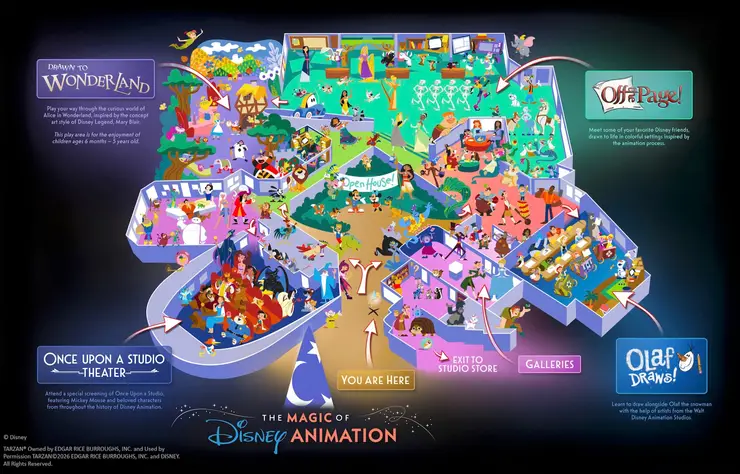
The centrepiece of the experience is Off the Page, an imaginative journey through different departments of an animation studio. This is where The Magic of Disney Animation really starts to distinguish itself. Rather than simply creating rooms decorated around Disney characters, Imagineers have built environments around the processes used to create animated films.
That means Story, Layout, Hand-Drawn Animation, Computer Animation, Lighting and Effects all become physical worlds. And, naturally, the characters have been assigned to the departments where they make the most sense.
Mulan appears within Story. Rapunzel takes over Layout. Chip ‘n’ Dale represent Hand-Drawn Animation. Donald and Daisy are found in Computer Animation. Goofy becomes the star of Lighting. And Stitch gets Effects.
It is a wonderfully Disney approach to what could otherwise have been a fairly technical subject. Instead of explaining animation through diagrams and displays, Disney puts the characters inside the process.
The result is a series of environments that feel like someone has taken the inside of an animator’s sketchbook and blown it up to human scale.
There is a real sense of discovery here. You are not simply walking towards the next character. You are moving through the stages that helped create the world those characters inhabit. That is a subtle difference, but an important one.
Mulan, Rapunzel, Stitch and friends are part of the story
Character encounters are, of course, a major part of the experience. But what I particularly like about the concept is that Disney has avoided making the characters feel like they have simply been dropped into a room because they need somewhere to meet guests.
They belong there. Mulan’s surroundings reflect storytelling and storyboards. Rapunzel’s setting explores the visual depth associated with animation layouts. Stitch’s Effects environment plays with the visual tricks and spectacle that animation allows.
It means the characters are not just the stars of the experience. They are part of the explanation. That is a clever piece of Imagineering because it gives the whole area a reason to exist beyond simply offering more opportunities for photographs. And there should be plenty of those.
The environments have been designed with visual storytelling in mind, meaning guests are surrounded by details that reward a closer look. It is the sort of space where children may be focused entirely on meeting a favourite character while adults find themselves examining the artwork, props and references around them.
That is classic Disney Parks design. Everyone gets something different from the same room.
Then Olaf teaches you how to draw
If Off the Page explains how animation is created, Olaf Draws! gives guests the opportunity to try it themselves. And this could easily become one of the most charming parts of the entire experience. Olaf acts as the host of an animation drawing class, guiding guests through the process of creating their own Disney character. The important thing is that Disney is not asking you to be an artist. You are simply being invited to have a go.
That feels increasingly valuable in a theme park environment where so much entertainment is designed to be consumed rather than created. For a few minutes, you are not watching a Disney character. You are drawing one.
The experience is hosted by an Audio-Animatronic Olaf, adding another layer of personality to the class. The character is perfectly suited to the idea, too. Olaf is curious, enthusiastic and just the right amount of chaotic to make the idea of an animation lesson feel fun rather than intimidating.
There is also the possibility of different characters being featured in the drawing lessons, which gives the experience some potential for repeat visits. It is a small thing, but it could be one of those experiences that families unexpectedly remember long after the day is over. Not because it was spectacular. Because they made something.
Wonderland, reimagined through Mary Blair’s eyes
For younger visitors, Drawn to Wonderland may be the most exciting discovery inside the building. Inspired by the concept artwork of Disney Legend Mary Blair, the play area takes Alice in Wonderland and looks at it through the eyes of an artist rather than simply recreating scenes from the finished film.
That is an important distinction. Mary Blair’s work has a distinctive visual language. Shapes are bold, colours are expressive and environments feel almost dreamlike. Disney has taken that artwork and transformed it into a three-dimensional play space. The Mad Tea Party, the Mad Hatter’s house, the Queen of Hearts’ rose garden and the strange, mysterious Tulgey Wood all feature within the environment.
For children, it is a playground. For adults, it is also a fascinating lesson in how concept art becomes physical space. That dual purpose is one of the strengths of The Magic of Disney Animation.
The experience does not assume that everyone visiting is interested in animation in the same way. A five-year-old can simply see somewhere exciting to climb and explore. A Disney history fan can look at the Mary Blair influence and appreciate the artistic decisions behind it. Both are experiencing the same place.
Once Upon a Studio comes to Hollywood Studios
Perhaps the most emotionally resonant element of the new experience is its connection to Once Upon a Studio. The animated short brought Disney characters from across generations together inside the real Walt Disney Animation Studios building, creating a love letter to the artists, films and characters that built Disney Animation. The Magic of Disney Animation takes that idea and turns it into a physical experience.
The Enchanted Gallery allows guests to interact with artwork and watch portraits seemingly come to life, bringing some of the magic of the short into the theme park. There is also a dedicated Once Upon A Studio Theater where guests can experience the short itself. This gives the attraction a heart.
Without it, The Magic of Disney Animation could simply be an impressive collection of animation-themed environments. With it, there is a bigger story. Disney Animation is not just about whatever film happens to be popular at the moment. It is about decades of characters, artists, stories and creative ideas building on one another.
Mickey and Minnie.
Snow White.
Cinderella.
The Little Mermaid.
The Lion King.
Frozen.
Moana.
And everything in between.
The gallery and theatre give the new experience a sense of history, while the interactive elements make that history feel alive rather than preserved behind glass.
Hollywood Studios feels more complete because of it
The arrival of The Magic of Disney Animation also solves a much bigger problem for Hollywood Studios.
For a long time, the park’s identity has been pulled in several different directions. There is the golden age of Hollywood. There is Pixar. There is Star Wars. There are modern Disney films. There are attractions about movies, attractions based on movies and attractions that have very little to do with the original concept of the park at all.
That evolution has produced some fantastic experiences, but it has also made Hollywood Studios feel less cohesive than it once did. The Walt Disney Studios Lot helps restore some of that cohesion.
It takes the park’s original fascination with filmmaking and applies it to one of Disney’s greatest creative achievements. Animation.
And rather than looking backwards nostalgically, it brings that idea forward.
The building may be inspired by Disney Animation’s real-world home, but the experience inside is unmistakably designed for today’s Disney Parks audience. There are interactive elements. There are character encounters.
There are spaces for children. There is technology. There are opportunities to create. There is plenty to photograph. And, crucially, there is still room for Disney storytelling.
The real magic is that you get to make something
There is a tendency in modern theme park design to judge an experience by how impressive it looks, how big it is, or how spectacular the technology behind it might be. The Magic of Disney Animation certainly has plenty of visual appeal, but its greatest strength may be something much simpler: it invites guests to take part. Whether you are exploring the studio, meeting Disney characters in their animation departments, bringing artwork to life, watching Once Upon A Studio, letting children explore Wonderland or sitting down with a pencil to draw a character yourself, the experience constantly encourages you to become part of the creative process rather than simply observe it.
That last part might sound almost too simple for a major new Disney Parks experience, but in many ways it is the perfect way to celebrate animation. Every Disney character, no matter how elaborate the finished film might be, began with the same basic ingredients: a pencil, a blank page and someone with an idea. The Magic of Disney Animation takes guests back to that starting point and, in doing so, tells a story that feels particularly appropriate for Hollywood Studios.
This isn’t an experience designed to remind us that Disney can build enormous attractions. We already know that. Instead, it reminds us why those attractions, films and characters exist in the first place. They began with imagination, with artists turning ideas into drawings and those drawings eventually becoming the characters and worlds that millions of people have grown up with.
Now, at Disney’s Hollywood Studios, guests get the chance to step inside that process and see a little of that magic for themselves. It is a quieter kind of Disney experience, but perhaps a more meaningful one. And judging by what has emerged from the Cast Member previews, The Magic of Disney Animation could be exactly the kind of thoughtful, creative experience that this corner of Hollywood Studios has been missing.